"World's recognized authority in power treatment"

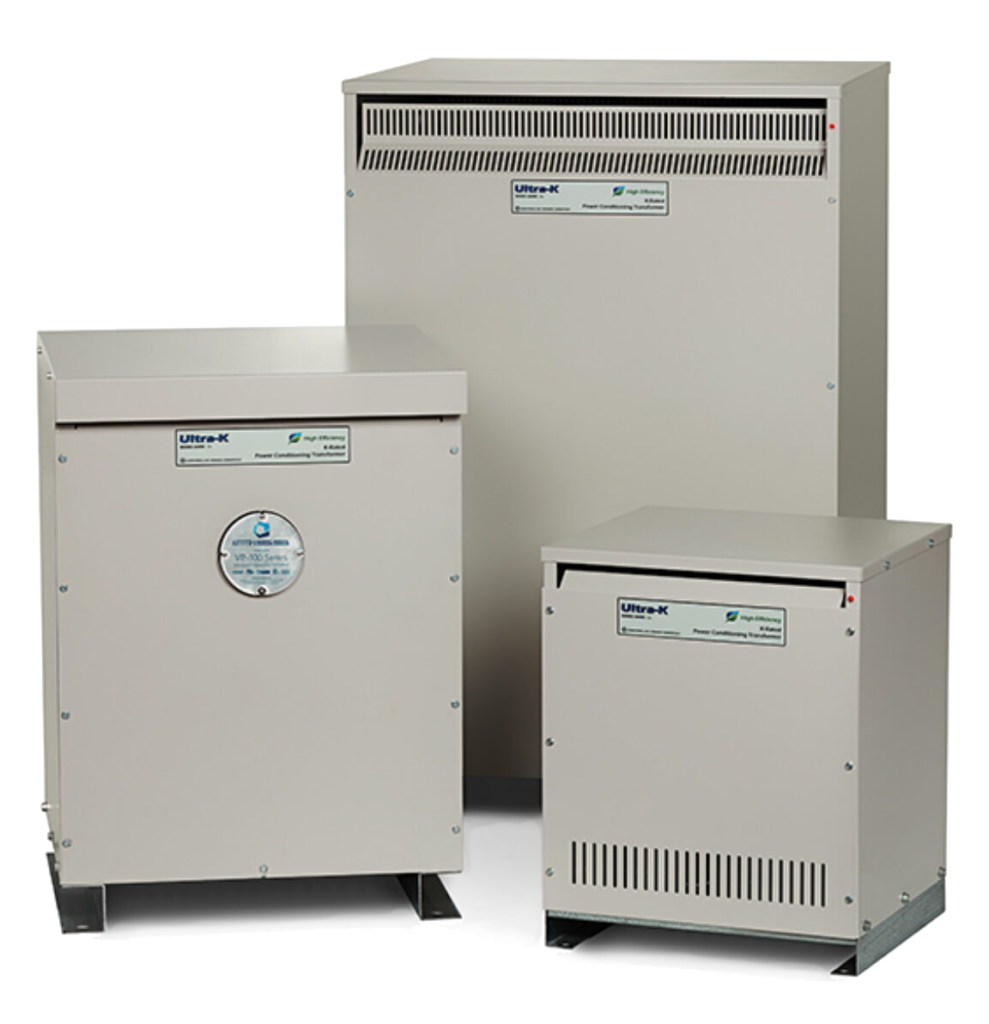
Ultra-K Transformer (5kVA - 500kVA)


Description
The Ultra-K is an all copper wound, K-rated, multi-shielded, high efficiency, computer grade, low impedance, isolation transformer. The Ultra-K provides voltage transformation as well as harmonic handling and attenuation plus a new ground-neutral reference for isolating equipment in buildings with high ground noise. The Ultra-K also provides high common mode and transverse mode noise attenuation, and fits perfectly in environments where there is a need for spike and ground noise protection.

The Ultra-K meets NEMA TP 1-2002 dry type distribution transformer efficiency standards under a linear load and is designed to achieve Table 4-2 efficiencies under a K13 non-linear load at or between 35% to 50% of its rating on models 30kVA and higher.

Single Phase Sizes: 5kVA, 8kVA, 10kVA, 15kVA, 20kVA, 25kVA

Three Phase Sizes: 15kVA, 30kVA, 50kVA, 75kVA, 100kVA, 112kVA, 125kVA, 150kVA, 225kVA, 300kVA, 500kVA


Features & Benefits
Technical Specs
Applications
FAQ


General Specifications


Guide Specifications


Back to top Top
Features & Benefits

  • Meets NEMA TP 1-2002 dry type distribution transformer efficiency standards under a linear load.
  • Designed to achieve Table 4-2 efficiencies under a K13 non-linear load at or between 35% to 50% of its rating on models 30kVA and higher
  • Multiple K-rating selection, K4, K7, K13, K20
  • All copper windings and conductors
  • Designed for linear and non-linear loads
  • Double sized neutral
  • Multi-tapped
  • Attenuates triplen harmonic currents from the line
  • UL Listed 1561 for K-factor operation
  • Double or triple shielded for high common mode noise attenuation
  • Excellent transverse mode noise attenuation
  • Optional filter for additional high frequency noise attenuation
  • K13 or higher capable of handling 100% non-linear load
  • Solves 88% of all typical power disturbance problems
  • Low impedance and low temperature rise
  • Category B3 load transient protection with optional TVSS
  • Optional input/output breakers on single phase units
  • Integral power distribution available (single phase)
  • Remote power distribution available (three phase)
  • International voltage options


Back to top Top
Technical Specs

  • Common Mode Noise Attenuation: 146dB (with triple shielding)
  • Efficiency 98% or higher
  • Load Regulation: Output maintained +/- 2% from nominal, from no load to full load
  • Output Impedance: 3% to 4% (size dependent)
  • 0°C to 40°C ambient
  • Output Harmonic Distortion: <1% Added
  • 200% Neutral
  • Overload: 500% for 10 sec, 1000% for 1 cycle
  • K4, K7, K13, K20 Ratings


Back to top Top
Applications

  • Recording Studios
  • Commercial / Residential Movie Theatres
  • Server Rooms
  • Diode and SCR Rectifiers
  • Variable Speed Drives
  • Inverters
  • UPS's
  • Frequency Converters
  • Arc Welders
  • Induction Heaters
  • Printing Presses
  • Non-Linear Loads
  • HID Lighting
  • Fluorescent Lighting
  • Voltage Transformation


  • What is a K-factor?

  • It is a value used to determine how much harmonic current a transformer can handle without exceeding it’s maximum temperature rise level. K-factor values range from 1 to 50. K-factor of 1 is used for linear loads only, and a K-factor of 50 is used for the harshest harmonic environment possible. A K-factor of 13 is typical. When transformers use a K-factor value, they are said to be K-rated.


  • What is a K-rated transformer?

  • A K-rated transformer is one which is used to deal with harmonic generating loads. Harmonics generate additional heat in the transformer and cause non-K-rated transformers to overheat possibly causing a fire, also reducing the life of the transformer. K-rated transformers are sized appropriately to handle this additional heat and tested to UL 1561 rigid standards for K-factor rated transformers.


  • How does a K-rated transformer deal with the heat generated by harmonics?

  • K-rated transformers use a double sized neutral conductor and either change the geometry of their conductors or use multiple conductors for the coils. Quality transformers are manufactured with a high grade silicon steel, copper windings, and more air ducts.


  • Where would I use a K-rated transformer?

  • Anywhere non-linear loads are present. New construction, renovations, factory automation, computer rooms, and office buildings are prime locations for K-rated transformers because of the high harmonic content in these areas.


  • How much K-rating do I need?

  • Typically a K-13 rated transformer is sufficient for most applications. Loads approaching 100% non-linear or more than 75% THD should incorporate a K-20 rated transformer.


  • Why are copper wound transformers better than aluminum?

  • Aluminum has a tendency to creep due to change in temperature. Creeping is the contraction and expansion of the aluminum conductors. When they creep: the terminal connections loosen, creating a hazard; they eventually burn clear; and shorten the life of the transformer. Copper is more efficient than aluminum. Copper wound transformers general save money; in many cases they pay for themselves over time.


  • Can the Ultra-K improve harmonic distortion?

  • Yes. There is a 30° phase shift between input and output waveforms. When this shifted waveform is applied against a non-shifted waveform, the 5th and 7th harmonics are greatly reduced. Also, in three phase applications, the triplen harmonics are trapped in the primary of the transformer and are not reflected through the building’s distribution grid. The properly coordinated impedance of the Ultra-K makes it a perfect solution for THD reduction and coordination of fault clearing devices.


  • How efficient is the Ultra-K?

  • The Ultra-K is 98% efficient. This high efficiency results in a low operating cost and the transformer is capable of convection cooling eliminating any cost and maintenance needed for fans or any other cooling devices. The Ultra-K meets NEMA TP 1-2002 dry type distribution transformer efficiency standards under a linear load, and is designed to achieve Table 4-2 efficiencies under a K13 non-linear load at or between 35% to 50% of its rating on models 30kVA and higher.


  • How does the Ultra-K help in distribution?

  • In single phase applications, the Ultra-K has three distribution options: Top panel receptacles, flexible extension cord with receptacle termination, and flexible extension cord with field wired termination. The three phase Ultra-K is hardwired in and out. Power distribution is accomplished by means of a Remote Power Distribution center (RPD) which incorporates a 42 pole board, input circuit breaker, and bottom access for flexible conduit.